Friday, 10 August 2012

Perth


(Magyar összefoglaló a végén)

The Boys College
Friday, 3 Aug, New Norcia - We packed up and left Cervantes under cloudy skies but soon after it started to rain and it rained most of the time while we reached New Norcia, including a few very heavy spells. New Norcia is a bit further inside from the coast along the Great Northern Highway, about 160 km from Cervantes, 130 km North of Perth. It was established in the 1850s by two Spanish Benedictine monks and is still a working monastery. We arrived here around 11 am still in heavy rain, but by the time we started to set up the van the rain stopped and we were lucky again with a mostly sunny afternoon. There is no caravan park here, but the roadhouse has a few powered sites for caravans.
Aboriginal murals depicting the seasons
After lunch we went on a 2-hour guided tour of the township. The monastery itself is not open to the public as there are still 10 monks living there, but we saw the Abbey Church, one of the cottages built for housing aboriginal families, the old flour mill and the two chapels, for the boys and girls boarding colleges. After the tour we went through the museum and art gallery showing the history of the monastery and a collection of religious paintings and artifacts. Some of the objects came from Kalumburu, the Benedictine monastery established by Father Torres, the Abbot of New Norcia around the 1900s.

Saturday, 4 Aug, Perth - We were lucky again to pack up and leave New Norcia in the dry, but then there were a few showers on the way down to Perth. We met a large number of oversize heavy trailers going up North, most likely to the Pilbara mines, loaded with huge machine parts, some completely expanding over the two lanes of the road, so all vehicles Southbound had to pull off to the shoulder. It seems the mining boom is still continuing. 
We got into our pre-booked caravan park (Karrinyup Waters Resort) just after 11 and by 12 our van was nicely set up, again in a dry period between showers. After lunch and rest we went out to discover the close-by area. We investigated the parking conditions at Warwick train station where we can go to the city, drove along the closest beach, then checked out the closes shopping centre (Karrinyup). That was enough for today.

Yellow CAT
Sunday, 5 Aug, Perth - Today we went to discover the city of Perth. To the train station by car, then to the city by train, a 16-minute ride. We got there around 9.30 am, the city was deserted and the weather cloudy and cold. We benefited from the free central area transport (CAT) bus services, went a full round on the Red CAT line, then half of the Blue line to the Barrack Street jetties. It was an easy and comfortable way to get an overview of the city. 
The Bell Tower
At the jetty we saw the new Bell Tower, and the view of the Swan River. We took a ferry across the river to the South side and back, just to enjoy the view of the city skyline from a distance. Around noon the sun came out and we had a nice sunny afternoon. We had lunch and coffee then walked around the malls and did a bit of shopping. Then we went on the third, yellow CAT line from West to East. We came home by train around 5 pm. We found the public transport system very good, clean, efficient, user-friendly. It would be good to have such a good system in Sydney!...

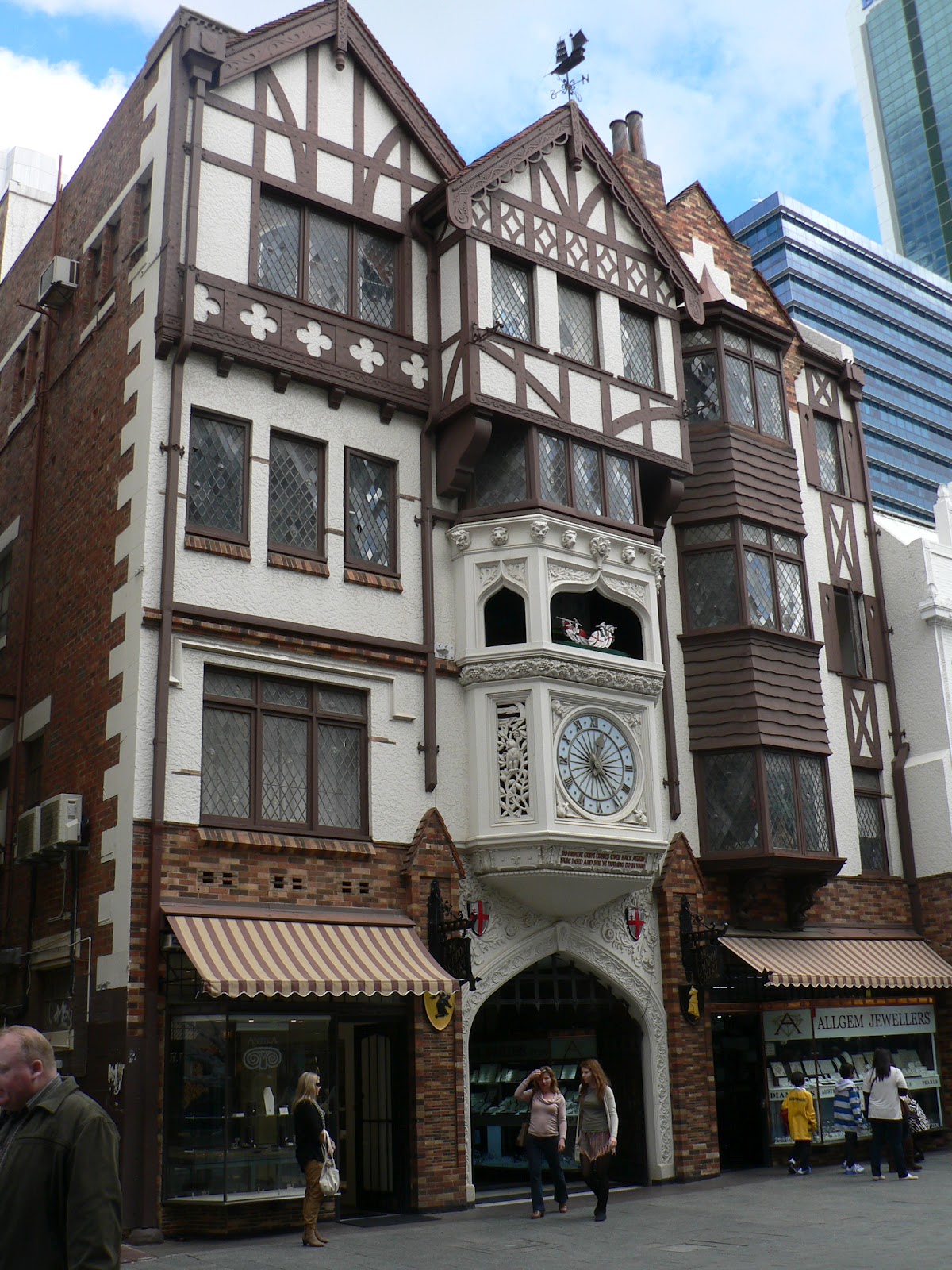
London Court on the Mall
Monday, 6 Aug, Perth - We spent the morning on some necessary business that is easier done in a large city, a medical test for Kate, some caravan repair inquiries, shopping, etc. Around midday we wanted to go to the city by train, but we could not find a parking space at the train station. So we ended up going in by car, about 12 km from here, and left the car in a garage. We had lunch and coffee, then went to the Art Gallery. There is an international modern art exhibition (Picasso to Warhol: 14 Modern Masters), but we were more interested in the standard collection, showing European and Australian paintings and other artworks from 1800 to the present. 
London Court Arcade
There are some very good paintings, my favourite was Frederick McCubbin's "Down on his luck", and some very good aboriginal works as well. The morning was sunny and windy but while we were in the gallery there was a big rainstorm, but it stopped by the time we came out. We went back to the garage and on the way home it was raining heavily again. It was the peak of the peak hour and the freeway was quite congested, but we never had to slow down to more than 25 km/h. Both in and out we made good use of our iPhone navigation system. And again, the rain stopped by the time we got home, so we did not get wet. Apparently we are not down on our luck... 

St Mary's Cathedral
Tuesday, 7 Aug, Perth - Today we went to the train station by bus, but this time we were down on our luck, there was a heavy shower while going to the bus stop. Apart from that it was a good journey and by the time we got to the city it was and stayed sunny most of the day, although very windy sometimes. First we went to St Mary's Cathedral, an award-winning example of how to fit new architecture with the old, and we liked it a lot, both inside and out. 
Perth Mint
The next stop was the Perth Mint, one of the biggest tourist attractions here and one of the oldest mints still working in its original premises. We browsed through the coin and nugget collections, we saw the second largest gold nugget in the world (26 kg), only found in 1995 in a dry creek bed. We have passed many dry creekbeds on our way, it may be worth paying more attention to these in the future... We saw a gold pouring performance and learned all the unique characteristics of this metal. It was interesting even if we are not too keen on anything gold in general.
View of the city from Mount Eliza
Then we went to the Harbout Town, a big shopping centre where we had lunch and coffee and looked for some more warm clothes as we realised that we packed far too many clothing for hot weather but not enough for the cold. After that we climbed up Jakob's Ladder, the 220 steps leading up to Mount Eliza and Kings Park, and enjoyed beautiful views of the Swan River and the city skyline under the afternoon sunshine. 
Walking along the edge of the escarpment we saw the State War Memorial, the statue of Queen Victoria and the majestic row of lemon-scented gum trees planted along Fraser Avenue at the centenary of the city in 1929.

Fremantle Prison
Wednesday, 8 Aug, Perth - Our destination for the day was Fremantle. In the morning we travelled by bus and train, with a transfer in Perth, and we got there by about 10 am. It was a nice sunny day but cool, not more than 17-18 degrees. First we visited the Prison, part of the World Heritage listed penal settlement system. Most of it can only be accessed with a guided tour that takes 1.5 hours. We did not want to spend that much time on this, but there were plenty to see outside. 
Cappuccino Strip
We walked around the centre, which has a nice uniform character with lots of old buildings and streetscapes. We had lunch at the Fishing Boat Harbour, at the "voted no. 1 fish & chips" restaurant. The food was good but nothing special. We had coffee in an Italian Cafe on the "Cappuccino Strip", a section of the South Terrace full of Italian eateries. 
Time Ball, Round House
We walked up to the Round House, the oldes public building in WA, originally a prison, and famous for the time ball and cannon fire at 1 pm to signal the exact time for the ships in the harbour, still done every day as a tourist attraction. 
Then we came back to Perth by a Captain Cook Cruise along the Swan River enjoying the views on the river and its banks, with many million-dollar mansions of the rich and famous. 
Gina Rinehart's mansion along the Swan river
The old library, now museum
Thursday, 9 Aug, Perth - We got up at 6am, and left the camp at 7 to take the car in to service at the other side of the town. Then we went in the city by train and spent most of the day in the WA Museum. We saw a nature photography exhibition, the Old Gaol, the geology exhibition "Diamonds to Dinosaurs". The rock and mineral samples, crystals, ancient animal and plant fossils and meteorite pieces were amazing, it is well worth a visit. After lunch in a nearby food court we went back to the Museum for the "WA Land and People" exhibition, an illustrated history of the past and present of the state. This is housed in the main hall of the old State Library which is now part of the museum, beautifully restored. 
Later we went back to pick up the car, and after recovering from the shock of how much it cost, we drove back to the city because we had an evening program. 
Heath Ledger Theatre
We had dinner, then we saw the "Signs of Life" by Tim Winton in the State Theatre (called Heath Ledger Theatre), a modern building opened a few years ago. The play is based on the same character as the novel "Dirt Music" that we both have read recently. It was interesting but I could not fully emphatise with it.

Friday, 10 Aug, Perth - This is a resting and housework day. Washing, shopping, cooking and reporting, staying in the camp most of the day. Another beautiful sunny and warm day after a very cold night. In the evening we will pick up our son, Marton, who spent the week here on work-related business, and now he will stay and travel with us for a week. He also organised an evening meeting with a fellow Hungarian colleague of his who is living here. Then tomorrow morning we will pack up and continue our journey to the South.

Our itinerary can be seen at the following Google Map:
http://g.co/maps/wcwv8 
(Note that to see the route after Bowen, you need to move down to the bottom of the left panel, and select the following pages!)

Múlt pénteken, aug. 3-án elindultunk Cervantes-bol és bejöttünk egy kicsit a szárazföld felé egy New Norcia nevu kis településbe. Ennek az az érdekessége, hogy két spanyol Benedek-rendi szerzetes alapította 1850 táján, és ma is egy muködo monostor, tíz szerzetes él itt és az egész városka erre épült. Eredetileg aboriginal családok "nevelése" és támogatása volt a céljuk, késobb építettek egy "fehér" fiú- és lány-nevelo bentlakásos kollégiumot is, de ma már ezek csak mint alkalmai szálláshelyek muködnek. Kb 60-70 család él itt, mind a monostor körüli gazdaságban dolgoznak. Délután egy kétórás túravezetés keretében megnéztük amit lehetett, sajnos a monostor maga nem látogatható, de láttuk a templomot, a két kollégium közösségi helyiségeit, a képolnákat, egy mintának meghagyott aboriginal lakóházat, a régi malmot, stb. Az egész érdekes szép régi spanyolos-szecessziós stílusban épült, helyi anyagokból és helybeli kézmuvesek és festok dolgoztak rajta. Van egy kis múzeum is, egyházi tárgyú képgyujteménnyel és helyi használati tárgyakkal. Érdekes volt az összefüggés a Kimberley északi végén, Kalumburu-ban látott szintén Benedek-rendi monostorral, amit az itteni fonök, Torres atya alapított. 
Itt aludtunk pénteken, ugyan nincs kemping, de a "roadhouse" (benzinkút) mellett helyet és némi alapszolgáltatást adnak lakókocsiknak.
Szombat reggel továbbindultunk és hamar beértünk Perth-be. Ez csak 130 km, útközben többször félre kellett állnunk, mert szemben rengeteg hatalmas túlméretes teherautó ment észak felé, óriási markológép darabokat és más alkatrészeket szállítottak, bizonyára a Pilbara-környéki bányákba. A kétsávos foút teljes szélességét elfoglalták, elöl-hátul forgalmi kísérokkel, érdekes látvány volt, úgy látszik a bányaipar továbbra is terjeszkedik. 
Perth-ben elore lefoglalt szállásunk volt, a város északi részén. Könnyen odataláltunk az iPhone navigációs programja segítségével. Azóta egész héten itt és a környéken nézelodtünk. Közben mindenféle praktikus dolgot is el kellett intézni, Katinak egy vér-kontroll vizsgálatot, a lakókocsinkhoz egy pár alkatrészt, az autót szervizelni, vásárolgatni. Az elso napokban elég sokat esett az eso és kellemetlen szeles-huvös ido volt, de kedd óta kitisztult és szép napos, bár árnyékban most is jó huvös, a napon meg jó meleg, nehéz megfeleloen öltözni. Azárt minden nap bejártunk, és megnéztünk minden fontosabb látnivalót. Olyan nagyon világrengeto látványosság nincs itt, de szép a város fekvése, a központ a Swan folyó partján fekszik egy lapos dombon, mellette egy magasabb dombon (Mount Eliza) van egy szép park (Kings Park), és a domb élérol szép a kilátás körben a vízre és a városközpontra. Busszal-vonattal jártunk be a városba többnyire, a tömegközlekedés ausztrál viszonylatban nagyon jó, a központban van három ingyenes buszjárat amivel mindent el lehet érni, és pihenni-melegedni is nagyon alkalmas a reggeli hidegben. Hétfon autóval akartunk a vonatállomásra menni, elég késon, tíz óra után, és nem tudtunk megállni, minden parkoló tele volt, úgyhogy végül autóval mentünk be és parkolóházban hagytuk az autót napközben, de az is egész megfizetheto volt. Viszont hazafelé a legnagyobb csocsforgalomban araszoltunk az autópályán, szóval jobb a busz meg vonat.
Mit láttunk? Van egy új harangtorony (Bell Tower), érdekes szép formája van, és a londoni St.Martin in the Fields kápolnából kapták a harangokat 2000-ben, a királyno ajándéka. Megnéztük az Art Gallery helybeli képgyujteményét, néhány kép nagyon tetszett. A St. Mary's Cathedral érdekes, díjnyertes példája hogy lehet egy régi templomot egy új résszel kiegészíteni-megnagyobbítani, nagyon tetszett. Perth Mint: ez a régi pénzverde, ma is ugyanott muködik ahol 120 évvel ezelott, érme- aranytömb- és aranyrög-gyujtemény van benne, közte a világon második legnagyobb aranyrög (26 kg), amit 1995-ben talált valaki egy kiszáradt patakmederben a felszínen - rengeteg kiszáradt patakmeder mellett mentünk el, ezentúl majd jobban körülnézünk, hátha...:))
A "Jákób létrája" 220 lépcsojén felmásztunk a Kings Park szélére, szép volt a kilátás és gyönyöru a növényzet. 
Egyik nap kirándultunk Fremantle-be, Perth kikötovárosába. A legfontosabb látnivaló itt a régi börtön épülete, a valamikor fegyenc-élet sok emlékeivel. A Round House közvetlenül a tengerparton szintén börtönnek épült eredetileg, fegyencek építették, ez volt a legelso középület az egész államban, és innen adták a pontos idojelzést ágyúlövéssel minden nap déli 1 órakor a kikötoben álló hajóknak. A kikötoben sok fish-and-chips evohely van, mi a "legjobb-nak megszavazott"-ban ettünk természetesen. Az egész városkának szép egységes régi stílusú épületei és utcaképei vannak. Onnan aztán egy másfél órás hajótúrával jöttünk vissza Perth-be a Swan folyón, megnzétük közben a helybéli milliomosok és milliárdosok folyóparton épült kacsalábon forgó kastélyait és a rengeteg kis- és nagyobb motoros és vitorlás yacht-ot. 
Csütörtökön "kulturális" napot tartottunk. Elotte még reggel elvittük az autót szervizbe, aztán vonattal a központba, és majd egész napot a múzeumban töltöttük. Láttunk egy természeti fotókiállítást, rengeteg fantasztikus állat-és növényképet, a geológiai kiállítást, ahol gyönyöru kozet-, ásvány-, elképeszto természetes kristály- és meteorit-gyujtemény van, meg csodálatos állati és növény-kövületek, egyik ámulatból a másikba estünk, ilyent még sosem láttam. Ebéd után visszamentünk még a Perth és Western Australia történetét bemutató kiállítást is megnézni. Aztán vissza az autóért, és miután magamhoz tértem a fizetett összeg miatti sokkból (de állítólag olyasmit csináltak meg amit muszáj volt, mert ha nem, késobb ötször annyiba került volna - elhigyjem?...), megint vissza a városba, mert még esti programunk is volt. Vacsoráztunk egy étteremben, aztán a nemrég épült "Heath Ledger" szinházban megnéztünk egy színdarabot, Signs of Life. Tim Winton új darabja, a Dirt Music c. könyv, amit mindketten nemrég olvastunk és élveztük, cselekményének a folytatása. Nem volt rossz, de nem igazán tudtam azonosulni a cselekménnyel. De jó volt egy kicsit szinházban lenni.
Ma (péntek, aug. 10) itthoni piheno és háztartási munkanapot tartottunk. Mosás, takarítás, rendezkedés, bevásárlás, fozés, és beszámoló-írás volt a program. Aztán késo délután megyünk felvesszük Marci fiunkat, aki már hétfo óta szintén itt van Perth-ben munka ügyben, és most egy hétig velünk fog utazgatni. Még ma estére megszervezett egy találkozót egy itt élo magyar származású kollégájával. Aztán holnap reggel felpakolunk és indulunk tovább dél felé.

Az útvonalunk a következo Google Map-on látható:
http://g.co/maps/wcwv8
(A Bowen utáni szakaszokhoz le kell menni a baloldali panel aljára, és a következo oldalakra kattintani!!)

Thursday, 2 August 2012

From Carnarvon to Cervantes


(Magyar összefoglaló a végén)


The one-mile jetty now
The jetty in its heyday from a mural
Thursday, 26 July, Carnarvon - We spent the day in and around Carnarvon, trying to get used to the colder climate. The morning was cold and windy, despite the sunshine, then it warmed up a little bit by midday. We went in the town centre, but most of it was cordoned off for reconstruction works. We drove out to the one-mile jetty and the old lighthouse, the lighhouse keeper's cottage and the old railway connecting the jetty to the town, now all managed by the local historical society. We drove around the small boat harbour on the other side of the town. 
Melon fields
The Dish
After lunch we went out to visit the "Dish", the OTC satellite earth station which was used to track the movements of the spacecrafts of the Apollo Moon project. There is a small museum beside the dish with lots of info, photos and memorabilia of the Apollo space program, it was interesting. Then we made a tour of the plantations on the two sides of the Gascoyne river, mostly banana and grape but many other fruits and vegetables as well. Finally we were invited to pre-dinner drinks to a couple with whom we have met several times along the way in the last week since South Hedland, Bill and Bosalin. They are also from NSW, previously living in Sydney, now retired to the North Coast near Taree. We had a good chat and it looks like we may still meet later as they are going on the same itinerary as us.


The shearing shed 
Friday, 27 July, Denham - We left Carnarvon in the morning and by lunchtime we got into Denham, about 320 km drive. The only event worth mentioning is that finally we have seen an emu, if only for a few seconds, just beside the road. Denham is in the Shark Bay World Heritage area, close to Mokey Mia. We had a site booked in a caravan park here for two nights. After setting up the van and having lunch we went to the info centre to discuss our program for tomorrow. Then we drove in to the Francois Peron National Park, just North of Denham. We walked through the heritage precinct, showing the life of the sheep station which was working here before the NP was established in the 1990s. 
The road to Big Lagoon
After that we went a bit further into the park, to a place called the Big Lagoon, which is supposed to have a unique flora and fauna. It was a 10 km narrow 4WD-only track on soft sand, for which we hed to reduce the tyre pressure to avoid getting bogged. We got in and out without any problems, but did not see anything very interesting. However, on the way back to Denham, just before reaching the town, we had a close encounter with another emu, this time it came out on the road just in front of our car, and walked ahead of us for quite a while, before wading back to the bush. So at least we saw some emus now.


They are coming!
Saturday, 28 July, Denham - The sky has cleared out during the night and we woke up to a clear sunny day. We got up early and had to leave Denham at 7 am to get to Monkey Mia by 7.45 when the first dolphin feeding starts. We were there in time, but the dolphins were not. There was a big crowd at the beach, but we could but wait, in fact they are wild animals, not working on strict schedule. Fortunately the weather was beautiful, clear sunshine although the air was still cold, we did not mind having two jumpers on. Finally they started to arrive around 9.15 and then the action began. For a while they just swam around getting closer to the rangers standing in the water, and at the end, some more helpers came down with buckets, and invited a few of the spectators to offer fish to the dolphins circling very close to the shore. There is a limit of 3 pieces for each dolphin and they know that, after the 3rd piece they turn around and disappear. Smart animals.
Dolphin feeding
Here is the dugong
Looking for dugongs
Next, we went on a boat cruise on the Aristocat 2, a motor-sailing catamaran. This is a boat licensed to go into the exclusion zone of the marine park and interact with the animals. The aim was to find dolphins and especially dugongs or any other interesting marine creatures, turtles, etc. We saw many more dolphins swimming and playing around the boat, lots of birds, cormorants, and after a lot of seraching we found a dugong and followed it for a long time, and saw it come up for air a few times very close to the boat. At the end we were taken to a pearl farm where our guide explained the whole process of pearling. It was a successful and enjoyable tour, especially in this clear sunny weather. The tour ended at 1 pm, then we had lunch at the Monkey Mia resort restaurant.
Cormorants in action
In the afternoon, having returned to Denham for a coffee break at home, we went out Southbound for a bit more sight-seeing. We stopped at Eagle Bluff, with nice views across Shark Bay, and two small islands just below full of birds. Then another stop at the town lookout. Finally we visited the little Anglican Church in Denham, built of unique shell blocks. 


Shell Beach
Sunday, 29 July, Kalbarri - Today we left Denham and travelled all day further South, with a few stops on the way. First we visited Shell Beach, a long stretch along Shark Bay where millions of small white Coquina shells have accumulated in a depth of 5 m or more. Over time the shells bind together in a kind of limestone, which is easy to cut into blocks and was used in the construction of old buildings like the Anglican Church in Denham. 
Stromatolites
The next stop was at Hamelin Pool, at the Southern end of Shark Bay. There is an old telegraph station from 1884 which is supposed to be a museum about the history of the region, but it is in very poor condition and closed. The main interest here is the stromatolites, the larges and oldest living fossils along the shallow and extremely salty water of the bay. These are colonies of micro-organisms that resemble the oldest and simplest forms of life found on Earth around 3.5 billion years ago. We walked along the boardwalk to see these rocky lumps, they don't seem such a big deal unless you consider all the history behind them. But the whole area is pretty nice, worth a stopover.
The rest of the day we drove down to Kalbarri. The landscape has changed gradually, with thicker and higher bush, even full trees, then cultivated land as we got closer to the Murchison river. The wildflowers are also starting to bloom, some areas are in yellow, others in pink. We arrived in Kalbarri around 5 pm, set up camp, and went out to a lookout at the mouth of the Murchison river in front of the town just in time to see another pretty sunset in the ocean. 


The Murchison River gorge
Monday, 30 July, Kalbarri - After a pretty chilly early morning, this was again a beautiful clear sunny day. We wanted to go on a whale-watching tour, but we found it is not running right now. So we went into Kalbarri National Park instead. A 25 km sandy dirt road took us to another beautiful gorge carved into the colourful layered sandstone by the Murchison river. The most famous feature is Nature's Window, a natural rock arch. 
Nature's Window
The Z-Bend
There are other lookouts with pretty views of the rock slopes and the meandering river. We had our picnic lunch at the Z-Bend, then came home for our coffee break.
Black Boys (grass trees) in Kalbarri NP
This is all we could see from a whale
In the afternoon we went looking for whales from the coastal lookout points, first at Eagle Gorge lookout, then at Red Bluff. We did not see whales as such, but we saw their air blows coming up from the water surface many times, quite close to the shore. For the moment that's what we have to contend with. But the coastal scenery itself was worth the time, especially in this nice sunny weather. Around sundown clouds started to seep in from the South and we can expect rain tomorrow according to the forecast. 
The Kalbarri coastline
Tuesday, 31 July, Kalbarri - Today we had a rest day, hardly leaving the van. In the morning the weather was not too bad, partly cloudy, but the rain has arrived in the afternoon as forecast, and it is still raining pretty heavily in the evening. This was our first rainy day since 24 May in Lawn Hill NP, but from now on we'll have more of these unfortunately. We spent the day resting, reading and doing some useful work on our computers, like tax returns. 


Greenough Historic Settlement
Wednesday, 1 Aug, Cervantes - The rain has stopped during the night and the sky has gradually cleared out in the morning. We packed up and continued Southbound on the coastal highway in nice sunny weather, among undulating hills and sand dunes on the right, with occasional glimpses of the ocean. At noon we stopped at the Greenough Historic Settlement, a small agricultural centre from the 1860s, renovated and maintained by the National Trust. We walked through the well preserved historic buildings, a school, a few cottages, two churches, presbytery, a police station and gaol, and a community hall. A few alpaccas were grazing peacefully around the site. After the walk we had lunch in our van and coffee in the Greenough Coffee.
Then we continued our drive along the coastal highway. Beautiful yellow flowering canola fields on both sides. The weather turned cloudy again and we were lucky to reach Cervantes under threatening stormy clouds but without any rain. We set up the van in the Pinnacles caravan park, and are hoping for better weather tomorrow, but the forecast is not looking good.


The Pinnacles
Thursday, 2 Aug, Cervantes - We woke up at first light to clear sky and went out for a walk around the deserted town and seafront. Back in the van, by 8 am it was raining, but the rain stopped around 9.30 so we quickly jumped in the car and drove out to the Pinnacles (Nambung National Park). There was clear sunshine by the time we got there and we had a beautiful drive around the 4 km loop among the thousands of limestone pillars sticking out of the yellow sand. An amazing view. 
We were also lucky to see a group of young emus chasing each other and doing a funny dance just in front of us. After the drive-through we visited the discovery centre to read about these rock formations and the flora and wildlife in the area. There are different theories about how these columns have formed but no general agreement. 


On the way back we stopped at the lobster factory processing the thousands of lobsters caught in the area and could not resist buying one - just to support the local industry... We had a very good lunch back in the camp and a quiet afternoon after this successful morning.

Our itinerary can be seen at the following Google Map:
http://g.co/maps/wcwv8 
(Note that to see the route after Bowen, you need to move down to the bottom of the left panel, and select the following pages!)


Az elmúlt héten folytattuk az utunkat dél felé, itt-ott meg-megállva egy-két napra. Csütörtökön (jul. 26) Carnarvon-ban voltunk, körülnéztünk a városkában de nem sok érdekeset találtunk. Van egy hosszú móló (one-mile jetty) amit már nem használnak csak történelmi ereklye, egy régi világítótorony és mellette az or régi háza, ma "múzeum", mindenféle régi bútorokkal és használati tárgyakkal. A város szélén van a "Dish", egy nagy parabola-antenna, amit az Apollo urprogramban használtak, mellette egy nemrég nyílt múzeum az urprogram részleteirol és az itteni kommunikációs központ szerepérol. Estefelé a kempingben összejöttünk egy házaspárral akikkel már több napja mindig találkoztunk, jót beszélgettünk egy kis borozás közben.
A következo két napot (jul. 27-28) Denham-ban és környékén, a Shark Bay Világörökségi területen töltöttük. Ez két párhuzamos tengeröböl közötti földnyelven van, szép helyen. A fo attrakció itt a tengeri élovilág, delfinek és dugong-ok (tengeri tehén, bár inkább az elefánttal van közeli rokonságban) élnek itt a védett öblökben, ahol az erosen sós víztol rengeteg sea-grass (tengeri fu) no, ezt eszik a dugong-ok. De a táj is érdekes és szép. Az elso délután elmentünk a Francois Peron nemzeti parkba, felautóztunk 10 km laza homokos nehéz úton egy elhagyott öbölbe (Big Lagoon), nem láttunk semmi különöset, de azért érdekes volt. Másnap reggel korán átmentünk a másik öböl partjára (Monkey Mia) ahol rendszeres delfin-etetés van minden reggel. Ott voltunk 7.45-kor, de a delfinek nem jöttek, vártunk rájuk másfél órát. Akkor mégis megjöttek, és láthattuk a nagy eseményt. Aztán elmentünk egy hajótúrára további tengeri állatok után nézni, ami végül is sikeres volt, láttunk egy csomó delfint, és egy dugong-ot is elég közelrol. Gyönyöru napsütéses ido volt, ugyan nem túl meleg, de így nagyon kellemes hajóút volt. Délután még egy kis körutat tettünk a másik öböl partján, néhány szép kilátópontról körülnéztünk, sok vizimadarat láttunk, foleg kormoránokat munka (halászat) közben.
Ezen a vidéken végre láttunk emu-t is, amit már korábban hiányoltunk. Most két alkalommal is az autónk elé jött egy közvetlen közel, jól megfigyelhettük, elottünk ment az úton hosszában egy darabig, aztán letért vissza a bozótba.
Vasárnap (jul. 29) indultunk tovább Denham-ból, de még útközben további két érdekességnél megálltunk a Shark Bay mellett. Az egyik a Shell Beach, csupa apró kagylóból áll a tengerparti föveny vagy száz m szélességben és 5 m mélységben. Idovel az eso kioldja a kalciumot a kagylókból és azok össze-cementezodnek természetes beton-szeru tömbökké, amit régen bányásztak és építkezéhez használtak a környéken. A másik a Hamelin Pool, az egyik öböl legmélyén, egy régi telegráf állomás, ma múzeum lenne ez is, de nagyon rossz állapotban és zárva. Valamikor ez volt a külvilági kapocs a környezo juhtenyészto farmoknak. A gyapjút is innen szállították el hajóval. De az igazi érdekesség itt a "stromatlite"-ok. Ezek évmilliókon keresztül megkövesedett mikro-organizmusok amik az öböl nagyon sós vizében tenyésznek most is és érdekes gomba-formákat alakítanak a víz szélén. Ezeket tartják a legosibb élo szervezeteknek a földön. Ránézésre nem mutatnak nagyon sokat, de a történetük érdekes, és az egész környék nagyon szép.
A következo 3 napot Kalbarri-ban töltöttük. Vasárnap estefelé értünk ide, ez is nagyon szép  tengeparti vidék a Murchison folyó torkolatánál. Már útközben láttunk szép megmuvelt földeket, hosszú ideje eloször. Hétfon (jul. 30) elmentünk a város mögötti nemzeti parkba, újabb kanyonokat nézni. A Murchison folyó le-föl kanyarogva 150 m mély kanyont vágott a vörös homokko sziklába, ennek egyes szakaszait néztük meg több kilátópontról és kis gyaloglással. A leghíresebb pontja a Nature's Window "a természet ablaka", egy természetes homokko boltozat egy kiugró hegyoldalon, de több más szép ponton is megfordultunk. Szerencsénkre megint nagyon szép tiszta napos ido volt ez is hozzájárult a látványhoz. No meg a rengeteg vadvirág, amik mostanában kezdenek elobújni, helyenként csupa sárga vagy lilás az egész mezo. Délután meg a tengerpart mentén látogattunk meg több kilátó-pontot, bálna-vadászat céljából, mármint csak szemmel és fényképezogéppel. Most folyik a bálnák észak felé vonulása, ez a város az egyik legjobb hely ahol a part közelébe jönnek. El akartunk menni egy bálna-nézo hajótúrára de sajnos nem ment most egy sem, így a part mellol próbáltunk leselkedni. És láttunk is, illetve a testét nem, de a fellövellt gozfelhot sokat láttunk egész közel a parthoz is. Sajnos kiugrani most éppen egyiknek sem volt kedve, pedig azt is szoktak, és a Ningaloo Reef-nél mi is láttunk olyat, de jó messzirol.
Kedden (jul. 31) egész nap a lakókocsiban üldögéltünk, rossz ido volt. Délelott még csak felhos, huvös, de délfelé megjött a beígért eso és jól zuhogott egész estig. Ez volt az elso esos napunk május 24. óta a Lawn Hill nemzeti parkban. Sajnos mostantól egyre több esore számíthatunk. Nem volt haszontalan nap, a pihenés-olvasás mellett megcsináltam az adóbevallásunkat is.
Szerda (aug. 1) reggelre elállt az eso, összepakoltunk és továbbjöttünk dél felé az Indiai óceán partját követve, hullámzó dombok és homokdunék között, újra tisza napsütéses idoben. Déltájban megálltunk a Greenough nevu régi kis településnél (1860-as évekbol) ami most skanzen-ként látogatható. Végigsétáltunk a foutcán és belenéztünk a megmaradt épületekbe, két templom, paplak, néhány lakóház, közösségi épület, rendorség és börtöncellák. Nagyon szépen rendbe vannak hozva. Néhány alpacca legelészett az épületek között, nagyon békés látványt nyújtottak a szép napos meleg idoben. Délután továbbutaztunk dél felé, egyre fenyegetobb viharfellegek között, elottünk-mögöttünk esett, de mi szerencsére eso nélkül megérkeztünk Cervantes-be és szárazon tudtuk felállítani a lakókocsit.
Csütörtök reggel majdnem tiszta égboltra ébredtünk és még napkelte elott (itt most csak 7 után kel a nap) elmentünk kicsit sétálni a tengerparton meg a városka kihalt központjában, de miután visszaértünk és megreggeliztünk, már esett az eso elég rendesen. Aztán fél tíz felé abbamaradt, és kiderülni látszott az ido. Gyorsan autóba ugrottunk és elmentünk a közeli Nambung nemzeti parkba megnézni a Pinnacles-t, ezért jöttünk ide. Ez egy tengerpart melletti homokdunés terület, ahol mészko oszlop-alakzatok ezrei merednek ki a homokból néha 3-4 m magasra. Egy 4 km-es hurokban lehet körülautózni a területen, megint szerencsénk volt, tiszta napsütésben sikerült végignéznünk ezt az érdekes attrakciót. Sot, még egy csapat fiatal emu is különelodást tartott nekünk, egész közel az autónk elott kergetoztek és furcsa táncot lejtettek elottünk, valamennyit sikerült is lefilmezni belole. A végén elolvastuk a történetét is a vendégházban, úgy látszik nem is tudják pontosan hogyan keletkeztek ezek az oszlopok.
Hazafelé bementünk a helyi lobster(homár)-feldolgozó üzembe, és vettünk egy frissen fogott és megfozött példányt ebédre, finom volt. Délután csak pihentünk és örültünk a jól sikerült délelottnek. 


Az útvonalunk a következo Google Map-on látható:
http://g.co/maps/wcwv8
(A Bowen utáni szakaszokhoz le kell menni a baloldali panel aljára, és a következo oldalakra kattintani!!)

Wednesday, 25 July 2012

Exmouth and the Ningaloo Reef


(Magyar összefoglaló a végén)


Thursday, 19 July, Barradale Rest Area - We left Tom Price and travelled most of the day towards Exmouth. This road is called the Warlu Way, a scenic tourist drive going through Paraburdoo, another mining town with an airport used mostly by the miners on a fortnightly fly in - fly out shift schedule. The landscape is interesting, rugged red rock hills following the road on both sides. Very little traffic. We reached the main road following the West Coast at the Nanutarra Roadhouse. After filling up the tank we went on another 70 kms and stopped for the night at the Barradale Rest Area near the Yannarie river, a vast flat dusty place near the road. A popular place, many other campers around, but enough space for everyone. After a good shower again we had a nice quiet evening and night, apart from the rumbling of the occasional road trains passing by.


The SS Mildura
Friday, 20 July, Exmouth - In the morning we drove in to Exmouth, about a further 200 kms, and set up the van at the pre-booked Cape Holiday Park. We went to the visitor centre and booked a full-day boat tour for tomorrow, hopefully to see some whale sharks. After lunch we went on a tour around the area, up to the West side. We stopped at the lighthouse to enjoy the views, then at the Northernmost point of the peninsula where the ruins of the SS Mildura are visible on the coral shore. Back in Exmouth, we saw the calm waters at low tide at Town Beach, and made a tour of the Marina. Most of the town is very recent, and a lot of new residential buildings, apartments, holiday homes are in construction. Looks like business is booming in this town.


Going snorkelling
Saturday, 21 July, Exmouth - Today we went on an all-day "whale shark" tour. We had to get up early, to be picked up at 7.10 am, but then we were taken to the dive centre shop, and had to wait a lot before any action took place. We had to select our gear, wet suits, fins and face masks, and wait for the other group members to arrive. Then we were taken by a small bus to the other side of the peninsula, where we boarded the boat. The boat was much smaller than I expected. First we went out just inside the reef and did a bit of snorkelling, to make sure that everyone is comfortable with their equipment, and for the tour guides to ensure that we are able to swim. The coral was interesting, as always, but not as colourful as on the East coast around Cairns. We saw some nice little fish. 
Swimming with a whale shark
Then came the main attraction: we went outside the reef, looking for whale sharks. These big fish (the largest fish on the planet, it can grow up to 20 m long) are spotted by helicopters and their location is reported to the tour operators. There are always many of them here around this time of the year. When they have located one for us, our boat went there, and we could jump in and swim beside these huge, amazing creatures. Usually it does not take long before we lose them, either they are swimming too fast, or they dive deeper. 
Face to face
A manta ray
We jumped in twice and saw one each time, quite close, a few matres away as they slowly move forward with their mouth open feeding on the plankton. The first one was about 4 m long, the second much larger, 5-6 m. On the way we also saw a few humpback whales breaching a few times not too far away, and later on some manta rays. It was a unique experience indeed, but we had to suffer a lot for it. Not so much in the water, with the wetsuits on and swimming as fast as we could it was ok, but when we came out of the water, sitting in the open, windy boat we were very cold. And unfortunately the weather was not ideal today, partly cloudy, strong winds, the sea was very choppy. Also, the boat was very small for that many people, hard to move around. So overall, it was not as good as we expected, especially for the amount of money it costed. Unfortunately most of the action occurred under water, so we could not take any photos. The ones included here were taken by our guide.
We came back around 3.30 pm, had a long hot shower to warm up, then a relaxing evening. 


Shothole Canyon
Sunday, 22 July, Exmouth - This morning we woke up to rain quietly pattering on the top of the van. This is how the weather remained all day, no wind, fully overcast, about 20 degrees, and light intermittent rain. They say Exmouth has about 320 days of sunshine every year, so today was one of the other 45 days. A pity, but again we are lucky it did not happen yesterday, it would have been even colder out on the boat.
Charles Knife Canyon
Nevertheless, we went out on a tour of the East side of Cape Range NP, about 20 km further South. First we drove along the Shothole Canyon road, a gravel road meandering along the floor, a scenic drive among the colourful rock layers of the sheer canyon walls. Then, another few kms further, the Charles Knife road climbs up the side of the Cape Range ridge in between two parallel gorges, offering fantastic views into the gorges. The road ends at the Thomas Carter lookout, with views of the whole peninsula and the ocean around it, very impressive even in this overcast grayish weather. On the way back we stopped at Pebble beach where Kate could not resist picking up a few memorabilia. 
Back in the van, we had lunch and a rest. In the afternoon we went shopping and hired two wetsuits for our planned snorkeling during the next two days on the West coast of the peninsula.


Our campsite at Pilgramunna
Monday, 23 July, Cape Range NP, Pilgramunna campsite - Two days ago we managed to book a place at this DEC-managed campsite, after some unsuccessful attempts earlier. So this morning we drove out here, at the other side of the peninsula, about 80 kms from Exmouth. The sky was still overcast when we left Exmouth but it cleared out by the time we got here. And this turned out to be a wonderful place, just beside the beach, in a small bay, only 9 campsites, all natural environment, sand dunes, and coral reef right here at the beach. We set up camp, and stayed here all day, enjoying the environment. 


A flock of cockatoos at the campsite
After lunch we went snorkelling. With our borrowed wetsuits the water was quite enjoyable, and the reef was fantastic. Here also, the coral is not as colourful as on the East coast, but the abundance and variety of the fish we saw very close was amazing. We stayed in the water for about 1.5 hours. Then we came back to the camp, and just rested, reading, walking around, cooking dinner, etc. The weather was ideal, sunny, warm but not hot, light breeze, just perfect. And again, a beautiful sunset in the ocean.


Yardie Creek Gorge
Tuesday, 24 July, Cape Range NP, Pilgramunna campsite - During the night we woke up to the noise of strong wind-gusts, and it remained very windy all day. In the morning we went to check out the other parts of the NP. First we drove South to the end of the sealed road at Yardie Creek. We walked up along the top of the escarpment of the gorge with nice views down to the creek and the red rock walls. Sometimes it was hard to stand agains the windgusts. 
Then we drove back Northbound to see some of the other beaches and bays along the coast. We stopped at the Oyster Stacks, another good place for snorkelling at high tide. 
Turquoise Bay
Then at Turquoise Bay, which seems to be the most famous and popular place, all the organised tours come here. The colour of the water is really turquoise and calm, and the whole area is really beautiful. It is also a good place for snorkelling. We were tempted to try it out, but did not have all the gear with us, so we went home.
After lunch we went snorkelling again. The water was a bit choppy and not as clear as yesterday, but we still saw a lot of different fish and corals. The rest of the afternoon we spent at the camp reading and resting. Later the sky became cloudy and by sunset it was almost fully overcast again. Just so that tomorrow morning we won't regret so much leaving this wonderful place...


Wednesday, 25 July, Carnarvon - Another frustrating windy night. The wind blew away the clouds, but woke us up many times. We packed up in the morning and went back to Exmouth, then continued our journey Southbound. We left with very good memories of this area, with the only regret that we did not see any emus, although the Exmouth tourist guide introduced them as "our reception committee".
Coral Bay
At lunchtime we stopped at Coral Bay, another small seaside resort at the Southern end of the Ningalo Reef. It is at the tip of a small headland, surrounded by white sandy beaches and sparkling blue and turquoise water, a beautiful place in the clear sunshine. We walked up to a lookout, went down to test the water, then had lunch and coffee.
Then off again, and a bit later we crossed the Tropic of Capricorn - unfortunately in the wrong direction... We have to say goodbye to the nice warm tropical days. The coutryside has also changed,  the almost barren plains that we saw earlier gradually got more and more vegetation, and a bit later we were surrounded by banana and other fruit plantations, the first cultured land since the irrigated santalwood blocks beside Kunnunurra. Soon we arrived to Carnarvon, the agricultural centre of the region, and checked into a van park. We got the first taste of cold weather, overcast, windy and 18 degrees, which felt as a shock after the last few months. We'd better get used to it.


Our itinerary can be seen at the following Google Map:
http://g.co/maps/wcwv8 
(Note that to see the route after Bowen, you need to move down to the bottom of the right panel, and select the following pages!)


Az elmúlt hetet Exmouth-ban és környékén, a Ningaloo Reef közelében töltöttük. Ez hasonló a Great Barrier Reef "Nagy korallzátony"-hoz a keleti partvidéken, de nem olyan hosszú, de legalább olyan érdekes és híres, ez is Világörökségi terület. 


Múlt csütörtökön (jul. 19) jöttünk el Tom Price-ból, másfél napot utaztunk Exmouth-ig, kb 650 km. A csütörtök éjszakát egy útmenti pihenoben töltöttük, elég kellemes volt. Pénteken (jul 20) délelott értünk Exmouth-ba, ahol elore foglaltunk szállást 3 éjszakára egy kempingben. Exmouth egy észak felé kinyúló félsziget keleti oldalán van, és a csúcsán meg végig a külso, nyugati oldalán van a korallzátony, tengeri természetvédelmi terület, a nyugati parton pedig végig az ún. Cape Range nemzeti park. Elso fontos dolgunk az volt, hogy helyet foglaljunk egy "whale shark" túrán, ami itt a legnagyobb szenzáció, szerencsére sikerült. Aztán délután körülnéztünk a környéken. Megnéztük a közeli beach-eket, a yachtkikötot, a félsziget csúcsán egy világítótornyot, és egy 1907-ben zátonyra futott hajó roncsait. Az egész város nagyon újnak tunik, rengeteg új üdülo és egyéb épület és további építkezések, láthatólag jól megy a turista-biznisz.


Szombaton (jul 21) mentünk a whale shark hajótúrára. A whale shark (bálna-cápa) a világon a legnagyobb halfajta, 20 m-re hosszúra is megno, pedig csak planktonnal táplálkozik. Július táján mindig sok van ezen a vidéken, ez itt a fo turista-attrakció. A cápát repülorol keresik meg a vízben, és a helyzetét megadják a hajónak. Amikor a közelébe érünk, a hajót a cápa haladási irányában kicsit eléje kormányozzák, ekkor egy vezeto-búvár (spotter) beugrik a vízbe és ha sikerült meglátnia a cápát (ezek általában közvetlenül a felszín alatt úsznak lassan, nyitott szájjal, és így szurik ki a vízbol a planktont), feltartja a karját a víz fölött, akkor lehet a magunkfajtáknak is beugrani a szemüveggel, pipával és úszótalpakkal, és a cápa mellett úszni, követni amíg bírjuk. Általában nem sokáig lehet követni, vagy túl gyorsan úszik, vagy lebukik mélyebbre, de addig a rövid ideig is fantasztikus látvány egy ilyen tengeri óriást közelrol látni a természetes környezetében. Ezt többször is meg lehet ismételni. Nekünk kétszer sikerült, persze ezek nem voltak olyan óriásiak, csak kb 5-6 m hosszúak, de egész közelrol nagyon nagynak látszanak. Valóban egydülálló élmény volt, de elég sokat kellett szenvedni érte. A túra majdnem egész napos volt, egy elég kicsi nyitott hajóban, eros szél fújt és nem volt nagy meleg, sokat fáztunk útközben a vizes búvárruhában. Útközben azért volt még más attrakció is. Eloször a korallzátonyon belül mentünk egy kicsit snorkel-olni, sok érdekes halat meg korallt láttunk, bár itt a korall nem olyan színdús, mint a keleti parton, de azért jó volt. Késobb, útközben láttunk bálnát is amint kiugrott a vízbol, de elég messze volt. A vége felé meg hatalmas manta rájákkal is találkoztunk, azok mellé is be lehetett ugrani, de már nekünk elegünk volt az akcióból. Sajnos ezen az úton a legérdekesebb dolgok a vízalatt történtek, így saját felváteleink nincsenek róla, de a vezeto búvárnak volt víalatti kamerája, tole kaptuk a blogra feltett képeket. 
Vasárnapra (jul 22) kicsit elromlott az ido, csepergett az eso, felhos volt, de azért kihasználtuk az idot. A félsziget keleti oldalán meglátogattunk két újabb kanyont, a Cape Range nemzeti parkban. Földúton kellett belemenni, az egyik (Shothole Canyon) a kanyon aljában haladt, a másik meg (Charles Knife) a felso peremén, mindkettonél sok szép vadregényes sziklás tájakat láttunk. 


Hétfon átköltöztünk a félsziget nyugati oldalára, a Cape Range nemzeti park egyik táborhelyére. Ezeket a táborhelyeket elore le lehet foglalni egy weboldalon, de ilyenkor nagyon nagy a kereslet, nehéz helyet találni. Eloször nekünk sem sikerült, de másodszorra találtunk egy helyet a Pilgramunna nevu táborhelyen. A számozott táborhelyek közvetlenük a tengerparton vannak, csak kis csoportokban, max 8-10 hely, az egyedüli szolgáltatás egy pottyantós wc, de ide minden felszereléssel együtt szokás jönni. A táborhelyünk nagyon szép volt, közvetlenül a parton egy kis öböl mellett, és egész közel a parthoz már ott a korall, lehet snorkelolni. Még vasárnap béreltünk búvárruhát Exmouthban, mert azért a víz nem olyan meleg, kb 22-23 fokos lehet. Két napot töltöttünk itt, mindkét napon mentünk snorkelolni, sok szép halat és korallt láttunk. Hétfon nagyon szép ido volt, napsütés, meleg, csendes, nagyon élveztük. Éjszaka aztán feltámadt a szél, és egész kedden erosen és egyenetlenül fújt, a hullámzás is nagyobb lett, a víz nem volt olyan tiszta, de így is jó volt azért. Kedden elmentünk egy kicsit körülnézni is a park többi tengerparti szakaszán. A Turquoise Bay a leglátogatottabb hely, idehozzák a turista-buszokat napközben, egész valószínutlen világoskék színu a víz benne. A park déli végében még egy kanyont is megnéztünk, még nem untuk meg.


Ma, szerda (jul 25) reggel indultunk tovább onnan, újabb kb 300 km-el délebbre, sajnos egyre huvösebb tájak felé. Délben még megálltunk a Coral Bay-ben, egy másik kis turista-település a Ningalo Reef déli végében, szintén valószínutlenül kék tenger és fehér homok szegélyezi, aztán kicsit késobb átléptünk a Baktérítot, és nemrég megérkeztünk Carnarvon-ba. Ahogy közeledtünk, banán-ültetvények meg szoloskertek jelentek meg, hosszú ideje most eloször láttunk megmuvelt földet, ez egy fontos mezogazdasági központ. És meglepoen hideg, felhos szeles ido fogadott, a 18 fok elég sokkoló volt, de most már ehhez sajnos hozzá kell szoknunk, végül is itt most tél közepe van. 


Az útvonalunk a következo Google Map-on látható:
http://g.co/maps/wcwv8
(A Bowen utáni szakaszokhoz le kell menni a jobboldali panel aljára, és a következo oldalakra kattintani!!)